What usually fails
Heat problems come from three places: the sensor, the heat source, or the door.
The sensor is a resistance probe in the cavity, usually at the upper left rear. Its resistance rises predictably with temperature and the control board turns that number into a temperature. As the probe ages the relationship drifts. A few degrees of drift shows up as slow preheat. Twenty degrees shows up as cookies that scorch on the bottom and cakes that sink. Nothing sounds broken, which is why people live with it for two years.
On electric ovens the heat source is a sheathed element, and elements fail the honest way: they blister, arc and open. Bake elements in built-ins are frequently hidden under the oven floor, so a dead bake element presents as an oven that browns the top of everything and cooks nothing through. On gas built-ins it is the hot surface igniter, and its failure mode is the one that misleads people. The igniter sits in series with the gas safety valve. The valve opens only when the igniter draws its rated current. An aging carbide igniter still glows bright orange while drawing too little to open the valve, so the customer sees light and no fire and assumes the valve is bad.
The door is the quiet third cause. A crushed or hardened gasket, or a hinge whose spring has taken a set, leaves the door sitting a millimeter proud. That vents cavity heat past the glass, drives long preheat times, cooks the touch panel above it and eventually takes out the control.
Self-clean is the other reliable creator of work. The cycle is legitimate, but it runs the cavity far hotter than baking ever does and it exposes anything marginal — the thermal fuse, the latch motor, a tired relay on the board.
How we diagnose it
We measure rather than infer. A calibrated thermocouple goes into the cavity, the oven is set to a normal baking temperature, and we log the preheat curve and then the cycling band over the following hour. That single test separates a drifted sensor from a weak element from a leaking door, because each produces a different shaped curve.
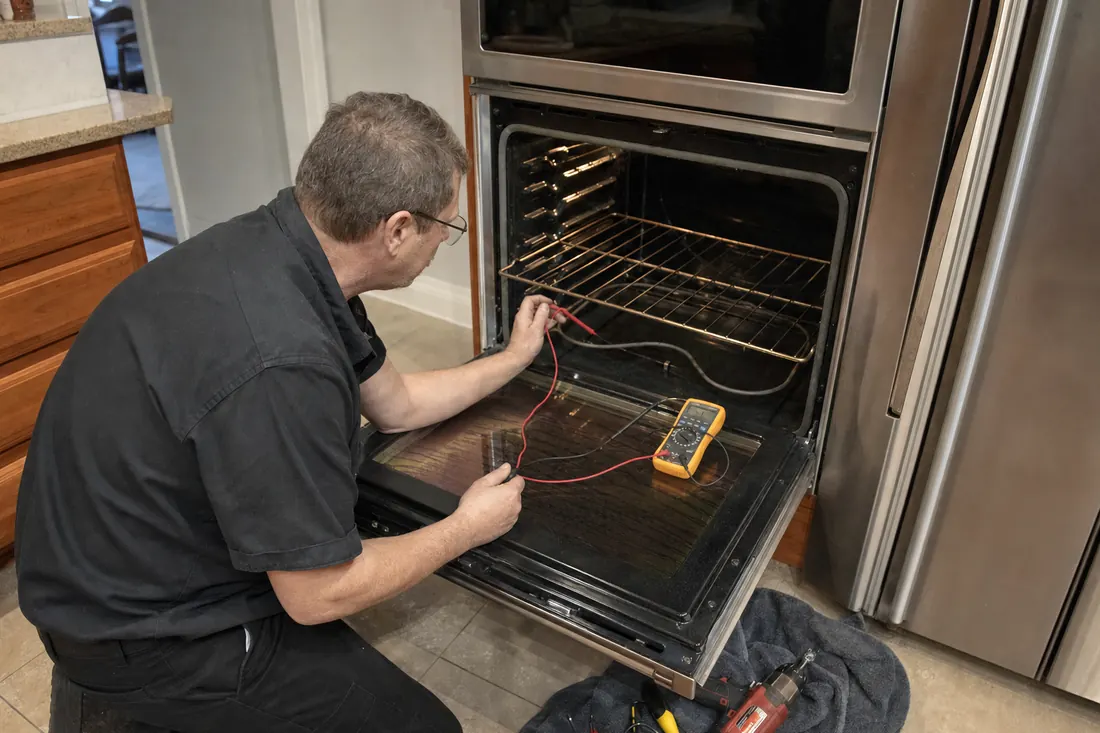
The sensor gets read cold and at temperature and compared against its published resistance table. Gas igniters get an amp clamp, not a look. Elements get an ohm reading and a visual on the terminals, where the burn usually is. On control complaints we check supply on both legs of the 240-volt circuit before condemning a board, and we look at the cooling fan and the vent path, because an oven built into a run of panel-ready cabinetry will cook its own electronics if that path is blocked.
What the repair involves
Cabinet protection first. Faces get covered, the floor gets covered, and the oven comes out onto a support rather than onto its own door. Trim screws are documented as they come out because the shim stack that made the oven sit flush in the opening has to go back the same way.
We install genuine OEM parts. Elements, probes and igniters are model-specific, and a generic igniter with a different current draw will start the same problem again in a year. After any heat-related repair the oven is recalibrated and run through a full preheat and bake cycle with the thermocouple still in the cavity, so the invoice reflects a measured result and not a hopeful one.
When it is worth repairing
Nearly always, and the reason is the cabinet. Built-in ovens are sized to a cut-out that a carpenter built around them, and cut-out dimensions change between manufacturers and between generations of the same manufacturer. Replacing a single built-in oven often means cabinet rework, new trim, and matching the finish of the ovens and warming drawers stacked with it.
Against that, a probe, an element or an igniter is a small repair. The one case where we advise against spending is a discontinued control board with no remaining supply and no reliable rebuild. We will tell you that on the first visit.
Independent service, based in Fruit Cove. Mon–Fri 8am–6pm, Sat 9am–4pm. Call +1 (904) 977-8701.