What usually fails
Sub-Zero’s freezer compartment is deliberately dry. That is the point of dual refrigeration: two separate sealed systems, two compressors, two evaporators, with the fresh-food side kept cool and moist and the freezer kept frigid and dry so frost never forms on the food. Heavy frost inside a Sub-Zero freezer is not normal behavior. It is moisture that got in, or a defrost circuit that stopped clearing it.
Where that moisture comes from, in the order we usually find it:
Door and drawer seals. A gasket that has hardened, torn or taken a permanent set lets humid room air in continuously. In North Florida that air carries a great deal of water, and every gram of it ends up as frost on the coldest surface in the compartment — the evaporator. Once the evaporator ices over, airflow drops, the compartment warms, and the compressor runs longer to compensate. Sub-Zero recommends a technician replace door and drawer gaskets, because the seat has to be set correctly or the new gasket seals worse than the old one.
The defrost circuit. Heater, terminator, thermostat and sensor. When any of these fail the evaporator never clears, and the compartment loses capacity over days rather than hours. That is why freezer failures get noticed at the ice cream and not at the meat.
The drain. When defrost water cannot get out it refreezes at the bottom of the compartment: a sheet of ice across the freezer floor, water in the drain trough, and eventually water dripping past the gasket onto the kitchen floor when the door opens.
Airflow. A restricted condenser makes the freezer system work harder for less result. On Classic and Legacy Classic cabinets the condenser sits at the top behind a flip-up grille. On Designer and Legacy Integrated columns, on the 700 Series and on undercounter platforms it is at the bottom, and if cabinetry has boxed in the kickplate the unit cannot breathe at all.
The freezer sealed system. Compressor, drier, evaporator, tubing. Less frequent, but this is where an honest diagnosis matters most, because it is the failure most companies will not repair.
How we diagnose it
Setpoint first, then reality. We take an actual compartment temperature with our own probe and compare it against the 0°F factory setpoint, then check how far the panel display has drifted from the truth. That gap is diagnostic on its own.
Then the panel history. EC40 on a 600, 648PRO, 700 Series or IC-27 column tells us the freezer compressor has been running excessively, and the size of the temperature deviation tells us whether to look at airflow or at components. A wrench icon and a chiming alarm on a Legacy Classic means a major error was logged. We read and record what is there before anything is cleared.
From there: condenser condition, evaporator coil condition behind the rear panel, evaporator fan draw, defrost heater continuity and terminator function, thermistor resistance against its curve, door switch operation, and a full perimeter check of the gasket. Where the electrical and airflow side comes back clean and the compartment still will not hold, we go to sealed system pressures.
What the repair involves
Defrost components, fans, thermistors, drain heaters and door switches are same-visit repairs and we stock the common ones. A frozen drain gets a controlled defrost, with the compartment brought up to room temperature and dried, not a wire pushed down the tube.
Gaskets are ordered per platform. A Classic gasket, a Designer gasket and a drawer gasket are three different parts. Control boards are verified against the serial tag before ordering, because revisions supersede and the correct board is serial-number dependent on several platforms.
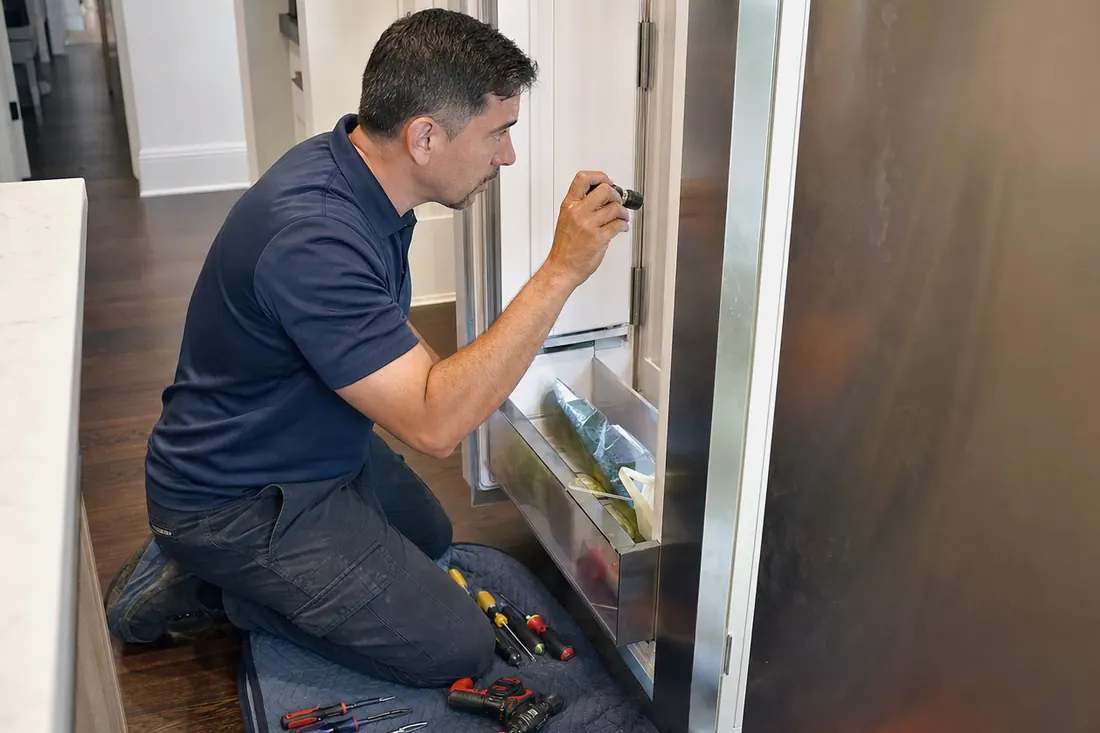
Sealed system work — compressor, drier, evaporator, connecting tubing — is done in your home by EPA Section 608 certified technicians, with refrigerant recovered rather than vented. On a Designer or Integrated freezer column, bottom-mounted access means drawing the unit out of its cabinet opening. That is a real risk to custom panels, stone floors and adjacent cabinet faces, so it gets protected before the column moves.
When it is worth repairing
The freezer usually holds the most expensive food in the house, which raises both the cost of waiting and the value of getting the diagnosis right the first time instead of watching a load thaw over three visits.
On the appliance itself: a built-in freezer column is furniture. It is trimmed into the millwork, carries a panel matched to the rest of the kitchen, and sits in an opening framed around that exact model. The mechanical parts inside are a small fraction of the replacement cost and they stay available for a long time.
The honest exception is a legacy cabinet with a corroded interior from years of an unaddressed drain leak, or one that has already had multiple unrelated sealed system failures. In those cases we will tell you it is finished. And if your unit is between its sixth and twelfth year, ask us about Sub-Zero’s limited twelve-year sealed system parts coverage before you approve anything — their own warranty terms allow an owner using non-certified service to obtain the covered part directly from Sub-Zero.