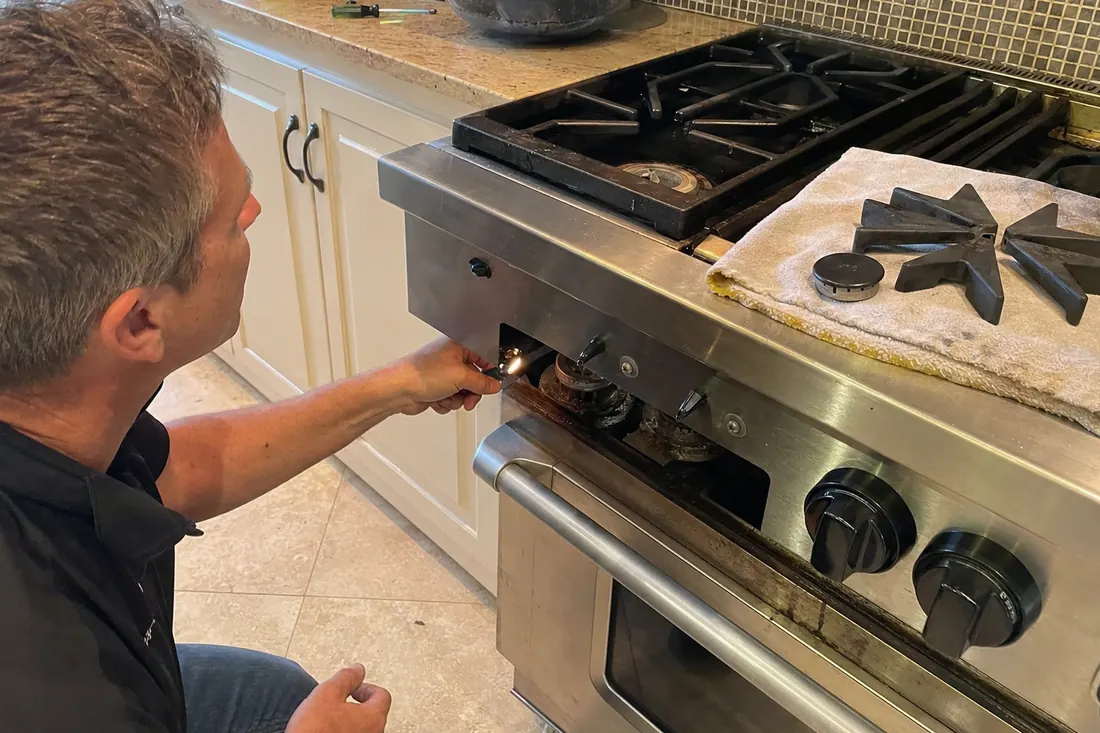
Ventilation is the part of a professional kitchen that gets ignored until it stops working, and then it becomes obvious very quickly. A 60,000 BTU rangetop under a hood that has lost half its airflow puts grease on the cabinets, moisture in the drywall and smoke in the rest of the house.
What usually fails
Blower motors fail on bearings, not on windings. The first sign is noise — a rumble or a howl that appears at high speed and later at every speed — followed by a motor that runs hot and eventually stalls. A squirrel-cage wheel that has been running out of balance because of caked grease will destroy the bearings long before the motor itself is worn out, so we always inspect the wheel, not just the motor.
Speed controls are next. On a variable-speed hood the control board delivers a different voltage or a different signal to the blower at each setting. When a stage fails you get a hood that works on high and nothing else, or one that only runs at full tilt. That is a board or a switch, not a motor.
Lighting is its own category. Halogen sockets discolor and lose contact from years of heat, and LED assemblies fail at the driver more often than at the diodes. Flickering across all lamps points at the driver or the transformer; one dark lamp points at the socket.
Then the parts that are not electrical at all. Backdraft dampers rust or jam, so the hood pulls against a closed flap. Duct runs get crushed during other trades’ work. Baffle filters seat incorrectly after cleaning and let grease bypass straight into the blower housing. And a hood that was ducted with too many elbows or too small a diameter never performed correctly from the day it was installed — no repair fixes that, and we will say so.
How we diagnose it
We establish the configuration first, because it determines everything else. Internal blower, inline blower in the duct run, or remote blower on the roof or exterior wall. A hood with a remote blower has power and a low-voltage control signal leaving the canopy and going somewhere else in the building, and half the faults we find on remote systems are in that run rather than in either end.
From there it is straightforward electrical work. We confirm supply voltage, then check what the control is actually sending at each speed setting, then check what the blower is receiving. If the blower gets the correct signal and does not respond, the motor or its capacitor is the fault. If it never receives the signal, the control or the wiring is.
Airflow gets checked at the hood face rather than assumed. A hood that measures well but does not capture is a duct, damper or filter problem. A hood that measures poorly with clean filters and an open damper is a blower problem.
What the repair involves
Canopy work is done on site with the cooktop and countertop covered. Blower assemblies on wall and island hoods usually drop out from below once the filters and the internal baffle plate are removed. Island hoods sometimes require lowering the canopy on its support rods, which is a two-person job and one we schedule as such rather than improvising.
Inline blowers in an attic are reached through the existing access. Remote blowers on the roof are assessed for safe access before we quote. Coastal salt air is hard on exterior blower housings, and a corroded housing sometimes has to be replaced along with the motor.
Control panels, lamps, sockets and dampers are usually a single visit. Motors and boards are ordered against the model and serial plate, which on most hoods is inside the canopy behind the filters.
When it is worth repairing
Nearly always. A professional hood is a steel canopy, a motor, a control and some lighting, and every one of those is a serviceable part. The canopy itself — the expensive, custom-sized, custom-finished piece — is what you are actually protecting, and it very rarely fails.
The exception is a hood whose original duct design was wrong. If the run is undersized, over-elbowed or terminating badly, replacing the motor buys you nothing. We would rather tell you that on the first visit than sell you a blower.
Appliance Repair Jax is an independent company based in Fruit Cove, serving Jacksonville and St. Johns County within a 40-mile drive. Monday to Friday 8am to 6pm, Saturday 9am to 4pm.