Troubleshooting
Pro-Style Range Oven Not Holding Temperature?
Burnt edges, long preheats, a cake that never sets. Sensor drift, calibration offset, a tired door seal and gas pressure each look the same from outside.
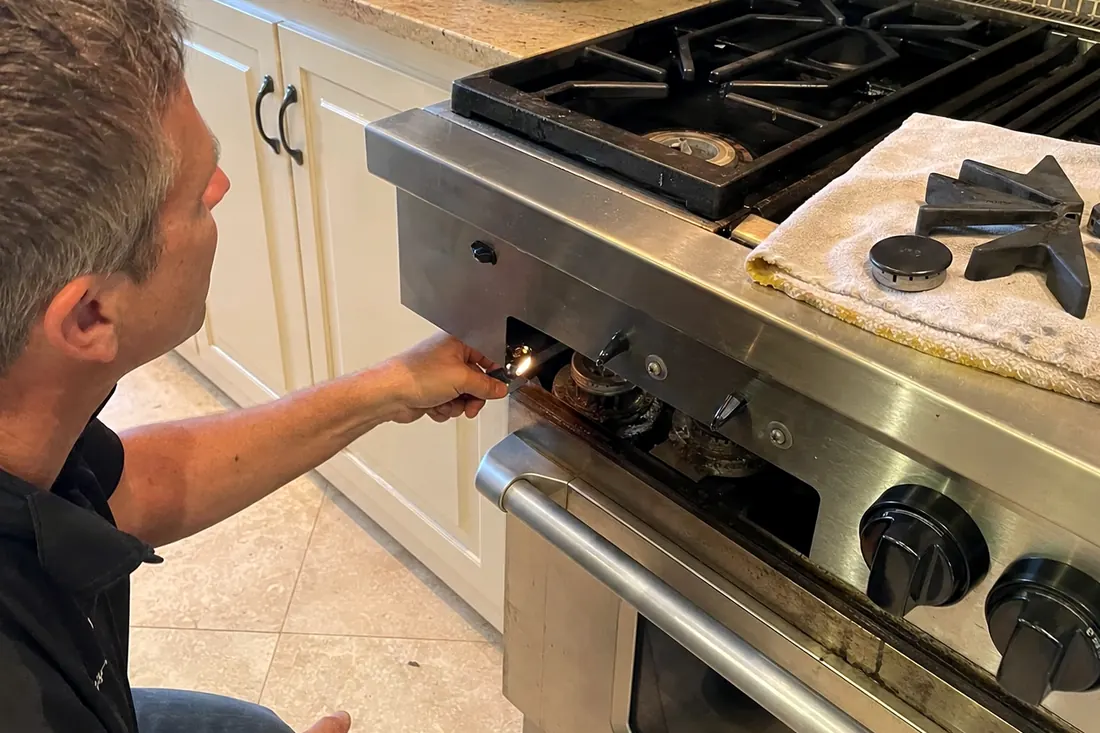
Some DIY experience helps
Involves removing a panel or a grille. Unplug the appliance first.
Covers these symptoms
- oven runs hot
- oven runs cold
- takes forever to preheat
- food burning on the bottom
- cakes not rising or sinking in the middle
- temperature swings up and down
- oven beeps preheated but it is not hot yet
What you need
- Oven-safe dial or probe thermometer rated to 500 degrees F
- Notepad and a timer
- Flashlight
- Sheet of paper
The complaint is always the same, the cause almost never is
“The oven is not holding temperature” arrives as burnt cookie bottoms, a roast that took ninety minutes longer than the recipe said, or a cake that sank in the middle. Those are all real, and they are all downstream of one of four completely different faults.
Sorting them takes a thermometer and about an hour, most of which is waiting. It is worth doing before you call anybody, because it changes what gets diagnosed and often what gets replaced.
First, decide whether you have an offset or a swing
This is the fork in the road and almost nobody takes it.
Offset means the oven is consistently wrong in the same direction. Set 350, it holds a stable 322. The control is doing its job well; it is being told the wrong number, or it is aiming at the wrong number. Causes: a drifted temperature sensor, a corroded sensor connection, a calibration offset somebody entered years ago and forgot, or a control that has lost its reference.
Swing means the average is fine but the oven wanders. Set 350, it climbs to 395, falls to 305, climbs again. The control is chasing a cavity that will not hold heat, or a heat source that is not behaving. Causes: a leaking door seal, tired hinge springs, a partly failed element, an unstable gas burner, a blocked convection fan, or a sensor mounted where it sees the element rather than the air.
You cannot tell them apart from the kitchen side. Both burn the same cookies. You can tell them apart with twenty minutes of readings.
| What your notes show at a 350 setpoint | Where to look |
|---|---|
| Steady 320-330, barely moving | Sensor drift or calibration offset |
| Steady 375-385, barely moving | Same, in the other direction, or a control fault |
| Averages 350, swings 310 to 390 | Door seal, hinges, or a heat source cycling badly |
| Never reaches 350 at all | Gas supply, a failed element, or a heating circuit not being called |
| Correct at 350, badly off at 450 | Sensor non-linearity or a control problem - a technician’s call |
Why the door matters more on a pro range than anywhere else
A pro-style oven door is heavy. It carries multiple glass panes, an insulated core and a substantial handle, and it is held closed against a gasket by hinge springs that have been compressed and released tens of thousands of times.
When those springs weaken, the door stops pulling itself square. It still looks shut. It still latches. But the top edge is no longer compressing the gasket, and a continuous ribbon of 350 degree air escapes across the top of the door. The control notices the cavity cooling and calls for heat more often, which is exactly what a swing looks like on paper.
The paper test finds it in two minutes on a cold oven. The hinge test finds the other half: open the door to halfway and let go. It should stay where you put it. A door that swings down under its own weight, or that has to be pushed the last inch to latch, is telling you the springs are done.
Gaskets themselves harden, flatten and tear, particularly the section that sits nearest the hinges and takes the most compression. On a range that gets a self-clean cycle regularly, the gasket ages faster - those cycles run the cavity far above cooking temperature, which is hard on every seal and every wire in the door.
Gas ovens have two extra suspects
If your oven is gas, there are failure modes the electric owner never meets.
Ignition delay and flame quality. The bake burner should light promptly and burn with a stable, mostly blue flame. A flame with lazy yellow tips, one that lifts away from the burner ports, or one that takes many seconds to establish is not delivering the heat the control expects, and the oven will chase temperature all cycle long. On many designs the safety valve only opens once the igniter has drawn enough current to prove it is hot, so a weakening igniter shows up as long delays before heat, then eventually as no heat at all - while the igniter still glows perfectly brightly. Glow is not proof of function on that design.
Supply and conversion. A range starved of gas cannot recover after the door opens and never quite reaches the high setpoints. One that has been converted between natural gas and propane without the correct orifices and regulator setting will run wrong permanently. We still find incomplete conversions on ranges that moved house with their owners, and on units bought secondhand.
The convection variable
If the range has convection, add two checks. The fan must actually run when convection is selected - stand close with the door closed and listen for it starting after the initial heat-up on models that delay it. And the fan’s airflow must not be blocked. A full-width sheet pan on the rack directly in front of the fan cover, or a stone slab occupying most of the cavity, turns a convection oven back into a badly ducted radiant one, and the temperature at the front of the cavity stops matching the temperature at the sensor.
Recipes written for conventional baking also assume a still cavity. Most convection settings run an automatic reduction of roughly 25 degrees F, and whether that reduction is applied by the control or expected from the cook varies by manufacturer. If your oven “started running hot” the week somebody discovered the convection button, that is worth ruling out before anything else.
The Jacksonville-specific ones
Two things genuinely change the odds here.
Power quality. Northeast Florida sees roughly 68 thunderstorm days a year, and the surges and brief dropouts that come with them are hard on oven control boards and on relays that switch heating loads. If an oven’s behaviour changed abruptly after a storm - a display that resets, a cycle that abandons itself, temperatures that went wrong overnight rather than gradually - suspect the control rather than the mechanics. Gradual drift is a sensor story; abrupt change is an electrical one.
Salt air on the coast. In 32082, 32250, 32266, 32233 and 32084 the sensor connector at the back of the cavity, the igniter terminals and the door switch contacts all corrode faster. A high-resistance connection at a temperature sensor reads as a cooler cavity than the real one, and the oven overheats to compensate. That is a five-minute fix that gets misdiagnosed as a failed control with some regularity.
What to do with the calibration offset
Almost every electronic oven control allows an offset to be entered, typically up to around 35 degrees F in either direction, through a key sequence in the owner’s manual.
Use it when the oven is honestly and consistently off by a modest, stable amount at more than one setpoint. That is what it is for.
Do not use it to bury a swing. Shifting the target on an oven that is wandering 80 degrees does not fix anything; it just relocates where the damage happens. And do not use it to compensate for an oven that is 60 degrees out, because a drift that large is a failing sensor or a failing control, and the offset will need moving again in three months.
When to call
Call if the oven never reaches setpoint, if the swing is more than about 25 degrees either side, if the offset needed is larger than the control allows, if a gas burner is slow to light or burning yellow, if the display resets or throws a fault code, or if the door has visible damage or a hinge that has failed. Leave any fault code on the display - the stored history is often the difference between one visit and two.
We are an independent appliance repair company in Fruit Cove serving St. Johns, Duval and Clay counties. Diagnostic is a flat $129, credited toward the repair when you approve the work. Call +1 (904) 977-8701, Monday to Friday 8am-6pm, Saturday 9am-4pm.
Step by step
- 01
Measure what the oven is really doing, not what it says
Hang an oven thermometer from the centre rack, set 350 degrees F, and wait a full 30 minutes after the preheat tone before you read anything. Then read it every five minutes for another 20 minutes and write every number down. You are looking for two things - the average, and how far it swings.
- 02
Separate offset from swing
An oven averaging 325 when set to 350 has an offset problem, which is usually calibration or a drifting sensor. An oven averaging 350 but wandering between 310 and 390 has a swing problem, which is usually the seal, the door, an element or burner, or the control cycling badly. The two need completely different fixes and the symptoms in the kitchen look identical.
- 03
Check the door seal and the door itself
Cold oven, door closed on a sheet of paper, pulled out at points all the way around. Anywhere it comes free without drag is leaking hot air. Then look at the gasket for flattened, hardened, torn or missing sections, and check whether the door sits square in the frame and closes fully without a shove.
- 04
Test the hinges
Open the door halfway and let go. It should hold position. A door that falls open, sags, or rests against the frame at an angle has tired hinge springs, and a heavy pro-style door that no longer pulls itself square against the gasket leaks heat continuously along the top edge.
- 05
Apply the calibration offset if the oven is uniformly off
Most electronic oven controls let you enter a calibration offset, commonly up to around plus or minus 35 degrees F, through a key sequence in the owner's manual. Use it only when the oven is consistently off by a steady amount at more than one setpoint. It is a correction for a small honest drift, not a way to paper over a failing sensor.
Never use the calibration offset to hide a swing of more than about 25 degrees F either side of the setpoint. That is a fault, and shifting the target simply moves where the fault does its damage.
- 06
Watch a full cycle with the light on
On a gas oven, look through the window during a heating cycle. The burner flame should be stable and mostly blue, ignite promptly, and shut off cleanly. Lazy yellow tips, a flame that lifts off the burner, or long hesitation before ignition all point at gas delivery or the ignition system rather than at the thermostat.
- 07
Rule out the obvious load errors before booking anyone
Stone or steel baking slabs left in permanently, foil laid on the oven floor, overcrowded racks and a convection fan blocked by an oversized tray all change how an oven holds temperature. So does opening the door to look. Remove everything that is not food, re-run the 30 minute test, and see whether the numbers change.
Questions this raises
How much temperature swing is normal in a working oven?
Ovens are cycling appliances - they overshoot slightly, coast down, and heat again - so some swing is by design. Roughly plus or minus 15 to 25 degrees F around the setpoint is ordinary, and the heavy cast and steel mass of a pro-style oven usually makes it tighter than that once fully soaked. Swings of 50 degrees or more, or an average that misses the setpoint by more than about 25 degrees, are worth diagnosing.
How long should a pro-style oven take to preheat?
Longer than a lightweight one, and that is the trade-off you paid for. All that steel and cast iron has to come up to temperature before the cavity is stable, which is exactly why it holds temperature so well once it gets there. Twenty to thirty minutes to a genuinely stable 350 degrees F is normal, and the preheat tone almost always sounds before the mass has caught up. Bakers should ignore the tone and use a timer.
Why does the oven read correctly but everything still burns on the bottom?
That is usually not a thermostat problem at all. A bottom-heavy bake, a stone or steel plate left on a lower rack radiating upward, foil on the oven floor blocking the intended airflow, or dark heavy pans will all scorch bases while the cavity average is perfect. If it started suddenly on a gas oven, look instead at whether the bake burner flame pattern has changed.
What actually fails in an oven temperature sensor?
Modern ovens use a resistance temperature sensor - a probe whose electrical resistance rises predictably as it gets hotter - and the control converts that resistance into a temperature. The probe can drift out of tolerance with age, the connection at the back of the cavity can corrode, and the harness can chafe. A technician measures the probe cold and hot against the manufacturer's resistance table rather than guessing, because a drifted sensor and a failing control produce identical symptoms.
Could my gas supply be the problem rather than the oven?
It can be, and it is worth checking before parts get replaced. An oven starved of gas heats slowly, struggles to recover after the door opens, and never quite reaches high setpoints, while an over-pressured one runs hot and scorches. Ranges converted between natural gas and propane also need the correct orifices and regulator setting, and a conversion done incompletely is something we still find on units that have been moved between houses.
Is it worth repairing an older pro range?
Usually yes. These are heavy, serviceable, mostly mechanical appliances built to be rebuilt, and sensors, igniters, thermostats, seals, hinges and burner parts are all replaceable at a fraction of replacement cost. The economics only turn when a discontinued proprietary control board is involved, and even then we will tell you honestly what the part situation is before you spend anything beyond the diagnostic.
If you would rather not