Troubleshooting
Gas Burner Keeps Clicking After It Lights?
A burner that keeps sparking after the flame is up is almost always wet or misaligned, not a failed module. Here is how to tell in about ten minutes.
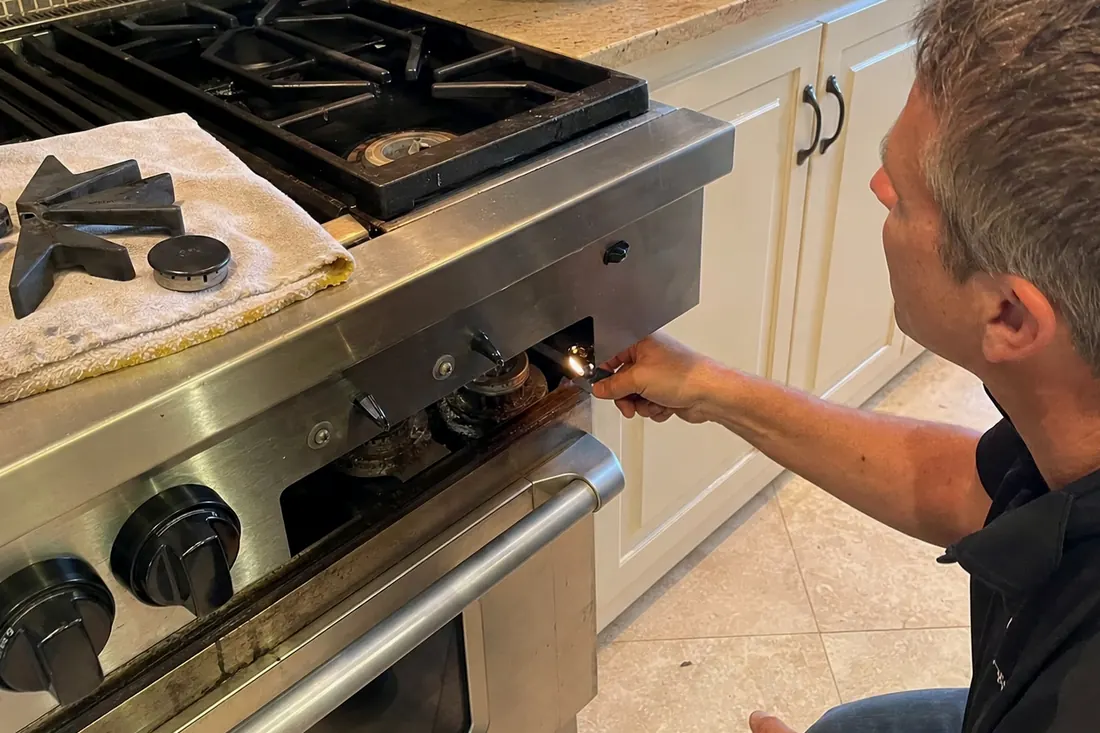
Anyone can do this
No tools, no disassembly, and nothing that can void a warranty.
Covers these symptoms
- burner keeps clicking after it lights
- all the burners click at once
- clicking with the knobs off
- burner will not light but keeps sparking
- clicking started after cleaning the cooktop
- clicking after a boilover
What you need
- Dry cloth or paper towels
- Flashlight
- Soft brush or an old toothbrush
- Straightened paper clip or a wooden toothpick
- Hair dryer, on low or cool
What the clicking actually is
The clicking is a spark. A module inside the cooktop is charging up and discharging across a small gap between a ceramic-tipped electrode and the burner head, thousands of volts at almost no current, several times a second. That spark is what lights the gas.
Once the burner is alight, the spark should stop. When it does not, the control has not received confirmation that a flame exists. Not that there is no flame - you can see the flame - but that the proof it is looking for is not arriving.
That distinction is the whole diagnosis. Nine times out of ten the burner is burning perfectly and something is interfering with the proof, and the fix is a towel and a couple of hours of patience.
How the cooktop knows a burner is lit
Two designs are in common use on premium gas cooktops and ranges, and they behave differently when they go wrong.
Flame rectification. A flame conducts electricity, and it conducts better in one direction than the other. The control passes a small alternating current through the electrode and into the flame, and looks for the rectified DC component coming back through the burner head to ground. It is an elegant test because only a real flame produces that signature. It is also a fragile one: the current involved is microamps, so a dirty tip, a flame sitting a few millimetres off the electrode, a corroded ground path or a damp insulator all reduce it below the threshold. The control decides there is no flame and sparks again.
Thermocouple or thermopile. Heat from the flame generates a small voltage that holds a safety valve open. Slower, simpler, and more common on older and on some professional ranges. A thermocouple that has drifted or is out of the flame produces a burner that lights and then dies a few seconds after you release the knob, rather than one that clicks continuously.
Either way, a cooktop that keeps clicking with a good flame is a proving problem, not a gas problem.
The four causes, in the order they actually occur
1. Moisture. By a wide margin the most common. A boilover, a wipe-down with a wet cloth, a pot lid dripping condensation, or steam from a stockpot running for an hour. Water sits in the well around the electrode and on the ceramic, and it gives the spark a low-resistance path straight to ground instead of a jump across the gap. The cure is drying, thoroughly, with the caps and heads removed, and giving it real time rather than ten minutes.
2. Burner cap or head not seated. The second most common and the most satisfying to fix. Every sealed burner has a cap that must drop fully into its register and sit dead flat. A crumb underneath, a cap rotated a few degrees, or - very often - two caps swapped between differently sized burners during cleaning, and the flame ring no longer sits where the electrode expects it. Lift each cap, wipe the seat, set it back down, and check it does not rock.
3. A dirty or misaligned electrode. Food debris bridges the gap, or carbonised spillage coats the tip. The gap between electrode and burner is small and specified, and an electrode that has been knocked while cleaning under the grates can end up too far away to spark reliably or too close to spark at all.
4. A cracked or carbon-tracked ceramic. The white insulator is what forces the spark to jump across the intended gap. Crack it, chip it, or let a carbon path burn across its surface, and the spark takes the easier route to ground. Tracking looks like a thin dark line on the ceramic. This one does not clean off; the electrode assembly gets replaced.
Only after all four are eliminated does the spark module or the knob-mounted ignition switch come into the conversation.
Why the whole cooktop clicks
This confuses more owners than anything else on the appliance.
On most sealed-burner cooktops there is one spark module, and it fires every electrode on the surface at the same instant. There is no per-burner control of the spark. So when the front left electrode is wet, the front right, rear left and rear right all click along with it, and it sounds like four failures.
The practical consequence is useful: you cannot identify the faulty burner by the noise. You have to inspect all of them. And a single wet electrode explains a cooktop that appears to have failed completely, which is why the first move is always to dry everything, not to start ordering parts.
The reignition feature is not a fault
Many professional-style cooktops continuously monitor each lit burner and automatically re-spark if the flame is extinguished - a pot boiling over, a draught from a door, a gust across an outdoor kitchen. That is a safety feature and it is working as intended.
It also means that on those cooktops, a marginal flame signal produces intermittent clicking during normal cooking. The burner keeps burning, the control keeps double-checking, and every few seconds it sparks once to be sure. It is not dangerous, but it is the cooktop telling you the flame signal is weak, and the causes are the same four above.
Where it becomes genuinely useful is on a burner set very low. A small simmer flame produces a small signal, and a burner that only clicks on the lowest setting is almost always one with a partly blocked port or an electrode sitting slightly too far from the flame.
Outdoor kitchens and coastal air
Outdoor gas equipment fails this way far more often than indoor equipment, and in this market that is a large fraction of the calls.
The mechanism is straightforward. Rain and irrigation overspray reach the burner area directly. Humidity sits high most of the year. And in the coastal ZIPs - 32082, 32250, 32266, 32233 and 32084 - the air carries salt, which is both conductive and hygroscopic. A salt film on a ceramic insulator does not dry out the way plain water does; it pulls moisture out of the air and keeps the surface conductive. That is why a coastal outdoor cooktop can click on a dry morning while an identical unit ten miles inland does not.
Two things help materially. Use the cover, but only once the unit is completely cool and dry, because a cover trapping warm moist air is worse than no cover. And rinse the burner area with fresh water occasionally rather than never - salt that is washed off cannot build up, and a rinse followed by proper drying beats leaving a season’s accumulation in place.
Do not do these
Do not spray any cleaner directly at an electrode. Do not use a wire brush or sandpaper on the ceramic. Do not enlarge burner ports with a drill bit or a needle file - the port size sets the flame characteristics and cannot be restored once it is opened up. Do not run the burner deliberately to “dry it out” while it is clicking. And do not keep using a cooktop that clicks with every knob in the off position.
When to call
Call if the clicking continues with all knobs off, if it is continuous rather than intermittent, if any ceramic insulator is cracked or has a dark track across it, if a burner sparks but will not light at all, if a burner lights then goes out a few seconds after you release the knob, or if you smell gas at any point. That last one is not a repair call first - get out of the house and phone from outside.
We are an independent appliance repair company in Fruit Cove, working St. Johns, Duval and Clay counties, indoor cooktops and outdoor kitchens alike. Diagnostic is a flat $129, credited toward the repair when you approve the work. Call +1 (904) 977-8701, Monday to Friday 8am-6pm, Saturday 9am-4pm.
Step by step
- 01
Turn every knob fully off and confirm the clicking stops
If clicking continues with all knobs in the off position, stop using the cooktop and book service. That means a switch is stuck closed or the spark module is being told to fire when nothing is calling for it, and continuous sparking near burner ports is not something to live with while you troubleshoot.
If you smell gas at any point, do not operate any switch. Leave the house, then call your gas supplier or 911 from outside.
- 02
Look at which burners are clicking
Light one burner and listen. On most sealed-burner cooktops the spark module fires every electrode simultaneously, so one wet or dirty electrode makes the whole cooktop click. That is the single most common cause and it is why so many owners think several burners failed at once.
- 03
Let it dry properly
Water in or around an electrode is the usual trigger. Turn all knobs off, lift the grates, remove the burner caps and heads, and dry everything with a cloth. Then leave the caps and heads off for two to four hours, or run a hair dryer on a low or cool setting over the burner area for several minutes. Do not put wet or damp parts back on.
- 04
Reseat every burner cap and head, one at a time
Lift each cap off and set it back down so it drops fully into its register and sits dead flat. A cap that is off by a millimetre, sitting on a crumb, or swapped with a different-sized cap from another burner changes where the flame sits relative to the electrode. That is the second most common cause and it costs nothing to correct.
- 05
Clean the electrode and the flame sensor
Find the ceramic-tipped probe beside the burner. Brush the ceramic and the metal tip clean with a soft brush, and clear any food debris from the small gap between the electrode tip and the burner head. Use a toothpick or a straightened paper clip on the burner ports too, never a drill bit or anything that could enlarge them.
- 06
Inspect the ceramic for cracks and dark tracking
Shine a flashlight on the white ceramic insulator around the electrode. A hairline crack, a chip, or a dark carbon line running across the surface all let the spark leak to ground instead of jumping to the burner. Once the ceramic is tracking, no amount of cleaning brings it back and the electrode assembly needs replacing.
- 07
Check the burner is actually seated in the venturi
On sealed burners the head drops onto a base and must sit square. If a head has been lifted for cleaning and dropped back at an angle, the flame pattern shifts, and on cooktops with reignition the control sees an unstable flame and keeps sparking to protect you. Rotate each head gently until it settles into position with no rock.
Questions this raises
Why do all the burners click when only one is lit?
Because most sealed-burner cooktops use a single spark module wired to every electrode, and it fires all of them together on each pulse. The module has no way to spark only the burner you turned on. So a single wet, dirty or cracked electrode anywhere on the cooktop produces clicking across the whole surface, which makes it look like a much bigger fault than it is.
Is it dangerous to cook while it is clicking?
Occasional clicking while a burner is lit is not itself dangerous, but do not ignore it. The gas is burning normally and the spark is doing nothing harmful. What matters is why the module still thinks the flame is unproven, and if the clicking is continuous, or continues with all knobs off, turn the cooktop off at the wall or the breaker and have it looked at before using it again.
My cooktop started clicking right after I cleaned it. What happened?
Water got where it should not be. Cleaning products and rinse water run down into the electrode well, and the ceramic holds moisture longer than the metal around it. Dry everything thoroughly with the caps and heads removed, give it a few hours, and it usually clears on its own. Cleaning the cooktop while burners are hot makes it worse, because the temperature difference pulls moisture into the gap.
What is the difference between the igniter and the flame sensor?
On many cooktops they are the same component doing two jobs. The electrode fires a spark to light the gas, then the control watches the tiny current that flows through the flame itself, because a flame conducts electricity. If that current is weak - a misaligned flame, a dirty tip, a corroded connection - the control concludes the burner did not light and keeps sparking, even though you can see a perfectly good flame in front of you.
Does the humidity here really cause this?
It contributes. Jacksonville sits at high relative humidity for much of the year, and coastal kitchens in Ponte Vedra Beach, Jacksonville Beach, Neptune Beach, Atlantic Beach and St. Augustine also get salt in that air. Salt is conductive and hygroscopic - it attracts water and holds it - so a film of it on a ceramic insulator gives the spark an easy path to ground. Outdoor kitchens have all of this plus rain, and they click far more often than indoor ones.
When is it actually the spark module?
When the electrodes are clean, dry, undamaged and correctly gapped, the caps are seated, and it still clicks - or when it clicks with every knob off, or fires continuously and never stops. A module that has stuck on is a replacement, not a repair. So is a knob-mounted ignition switch that no longer opens, which is the other component that produces clicking nothing on the cooktop can explain.
If you would rather not